There’s no doubt that one needs to have an understanding of the bias inherent in a given media platform as part of interpreting the news from that platform. It’s very clear that the polarization of politics south of the border are clearly evident in the various news outlets there. I wondered if there was a comparable diagram for Canada, and so I googled “media bias Canada Canadian chart” and discovered a number of interesting things by rooting through the search results.
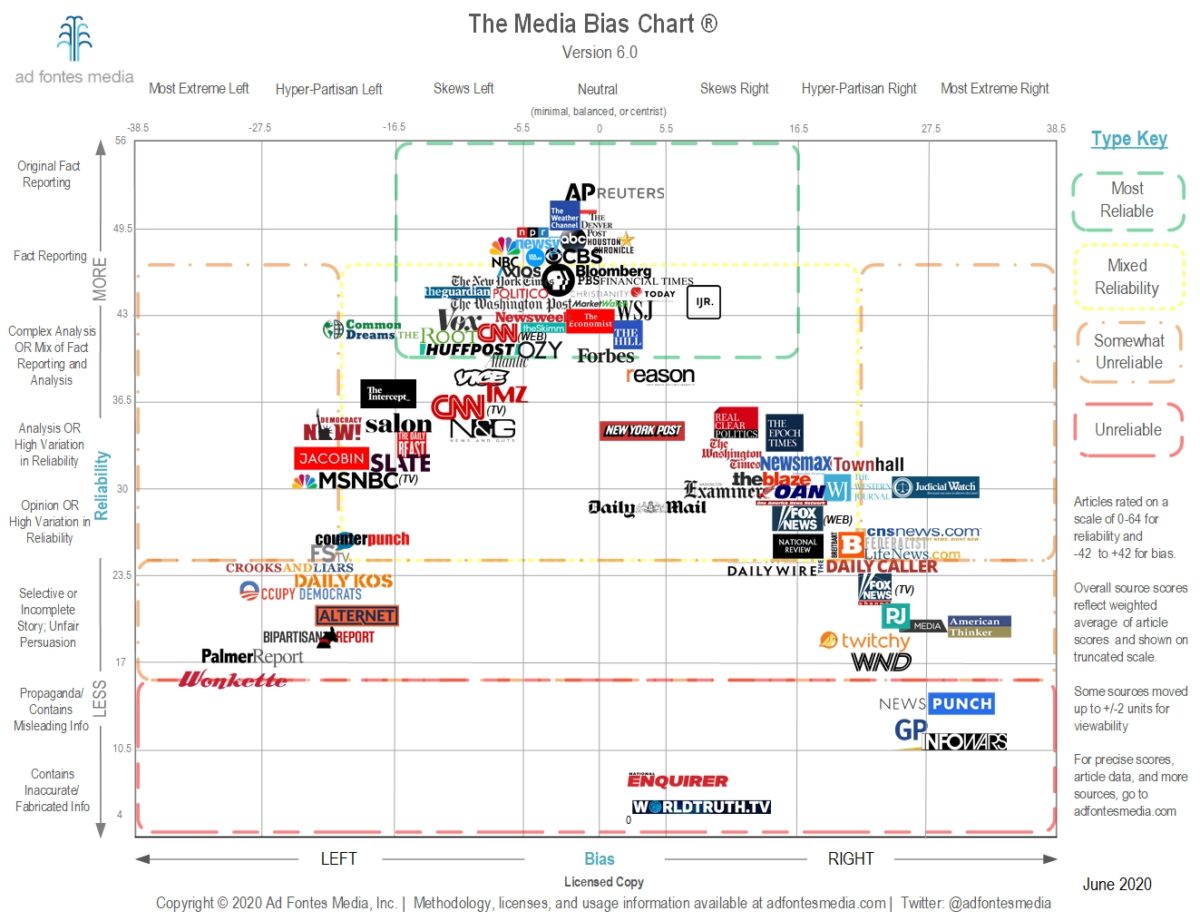
The Media Bias Chart 6, Ad Fontes Media
There is an updated version 6.0 (June 2020) of the Ad Fontes Media chart you have shared. It appears to incorporate even more media, but is navigable in the version 5.0 interactive form.
The Canadian Encyclopedia has a very nice article about the kinds of bias that can appear in the media, with examples from Canadian contexts.
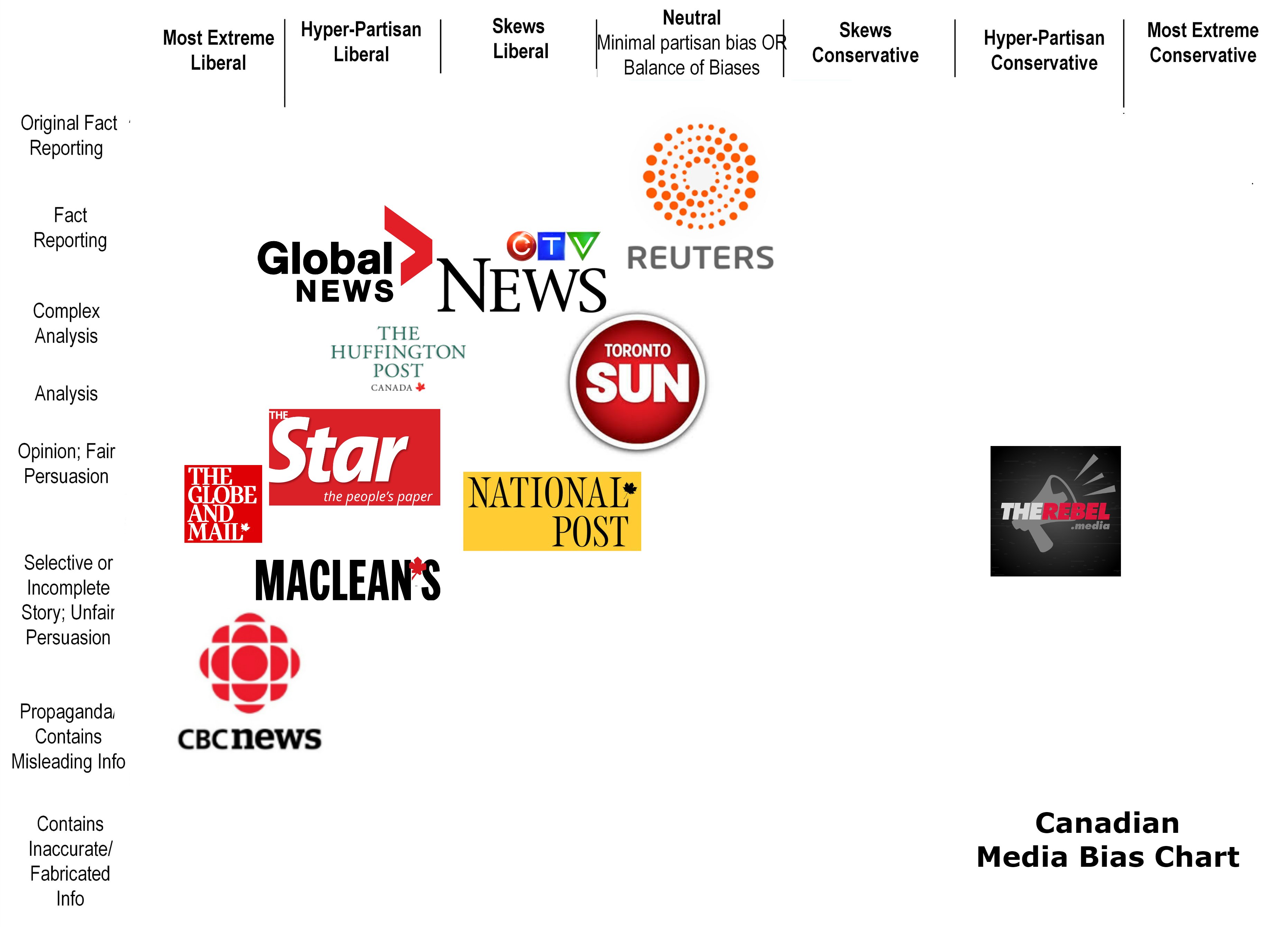
I did come across a “bias chart” of Canadian news media, posted on Twitter, however based on the attached tweet and other information surrounding the tweet, I question whether it is based on objective data or whether it actually represents a bias inherent in the poster/artist who created it?
Is there bias inherent in the following representation of the bias in Canadian media? There is no attached data or cited source to support this image.
unattributed source: “Canadian Media Bias Chart,” shared on Twitter
What do you think? How would you go about assessing the validity of this representation?
It would be interesting to know if Ad Fontes Media has data to support the verification (or creation) of a Canadian Media Bias Map.
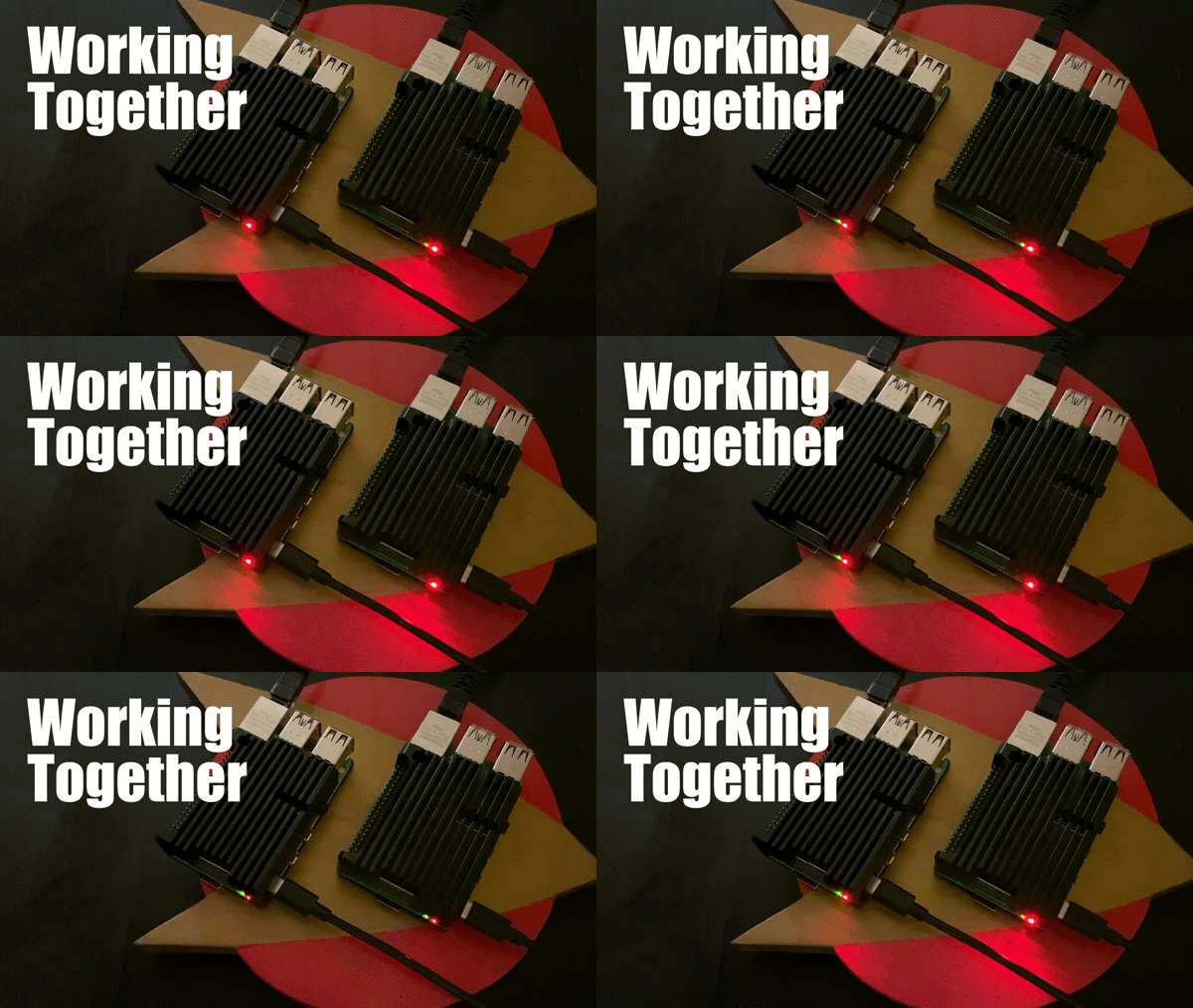
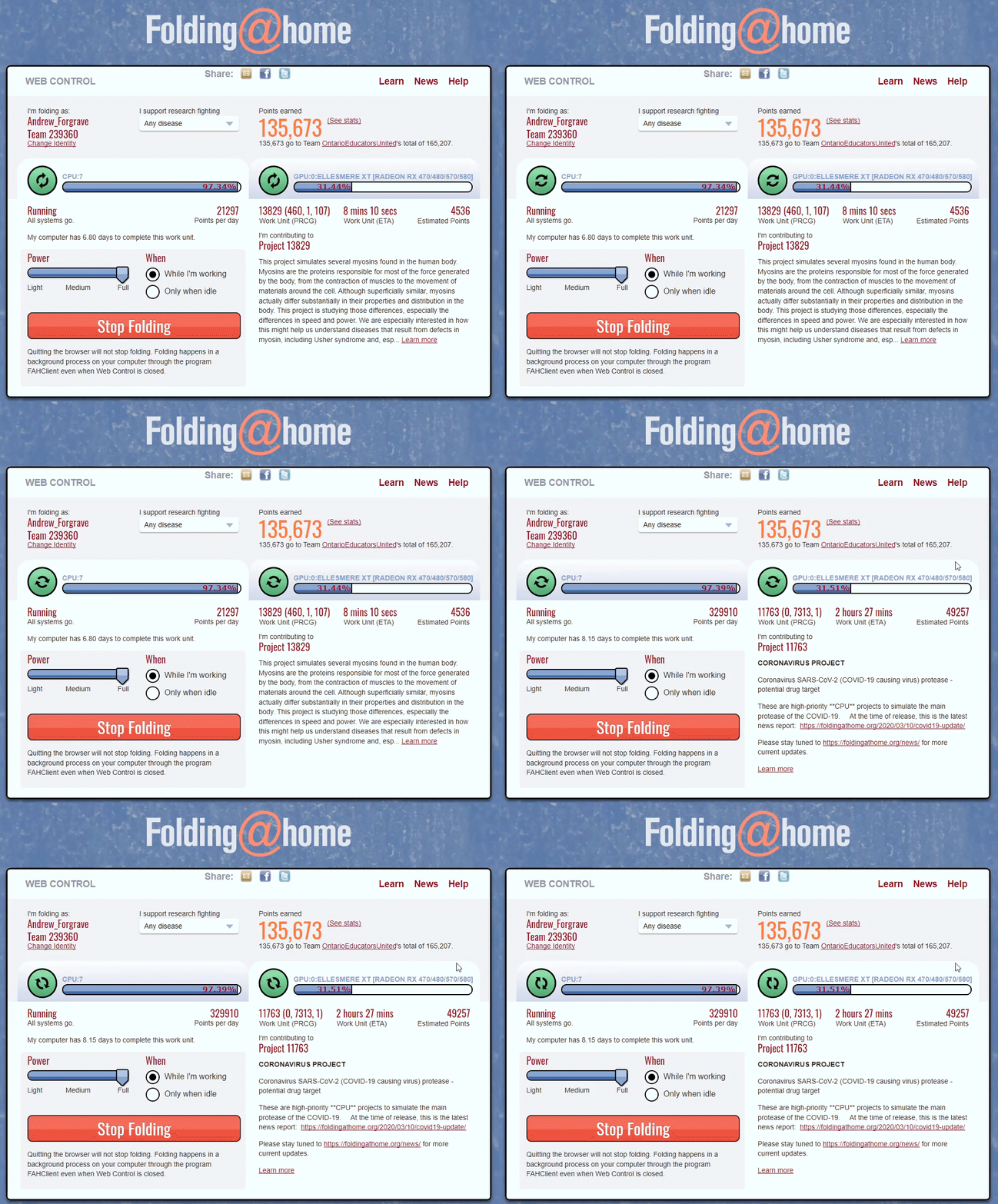
Two Raspberry Pi 4Bs running Rossetta@Home to fight COVID-19 (GIF by @aforgrave)
We are now eight weeks since the arrival of the pandemic and the shelter-at-home orders hit Ontario. Over the past 56 odd days, my daily efforts have been devoted to three “pandemic response” areas:
my “day job,” supporting the delivery of webinars teaching kids the principles of coding, AI, and computational thinking — 102 webinars and counting;
my “volunteer job” as president of the Educational Computing Organization of Ontario (ECOO);
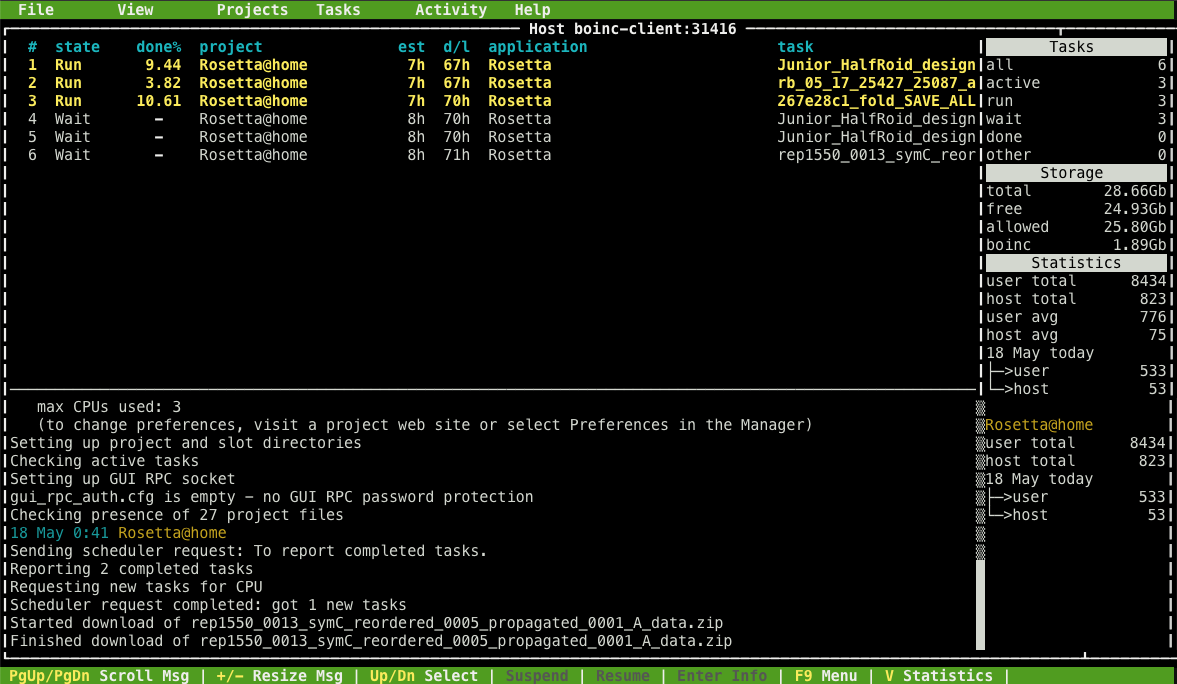
a little side project, contributing to the “folding@home” and “rosetta@home” wide-scale distributed computing endeavours as they seek to understand various diseases like cancers, and the current scourge — COVID-19.
In what might have been a fairly boring time to be recently retired and housebound, all three of these endeavours have allowed me to contribute, and, most importantly, have given me the daily opportunity to collaborate and work together with other folks. In the case of the day job, everyone got the “work from home” order on Friday March 13th, and since then, the days have been mediated by Zoom, Meet, and Slack calls, along with emails, slack chats, and lots of shared Google docs, spreadsheets, and presentations. In my case, I was already working from home, so that aspect of things didn’t change dramatically for me, but the nature of our communications now during work is mediated by an overarching sense of “all in this together,” and reflects a significant pivot from a face-to-face model to a completely online delivery model. Whether folks are in Montreal, Ottawa, Toronto, Winnipeg, Calgary, Edmonton, Vancouver, (or Belleville 🙂 ) this has worked because everyone is collaborating and working together to support the common cause. The daily fifteen minute online “breathe-breaks” during the noon hour are a great opportunity to take a brief pause together and reflect on the importance of wellness. Thanks to colleagues Maddy, Rita, Mavis, Matt, Gabrielle, Martin, German, Peter, Maia, La Donna, Maria, Maddie, Simon, and all the rest.
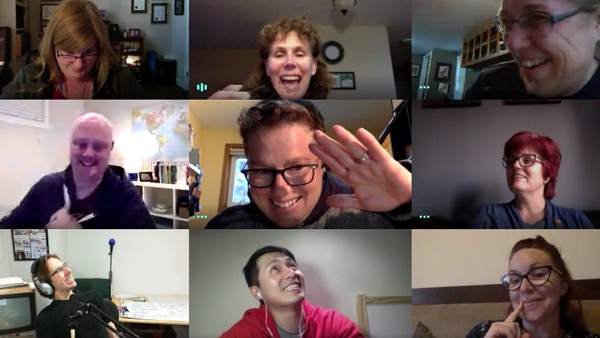
The ECOO Board of Directors during the May 4th Board Meeting (capture by @aforgrave)
Similarly, the ECOO Board of Directors responded to the arrival of the pandemic with an acknowledgement that our annual conference, Bring IT, Together (#BIT20) was likely in jeopardy, along with the regional #ECOOcamp events that were in the planning stages for the summer months. The Board collaborated in short order to develop a pandemic response plan, resulting in a number of us working long hours to revise the content on the ECOO.org website to support the current reality facing Ontario educators — teaching students at home, from home. Again, the importance of personal wellness and balance has been key, reflected on the landing page of the website and as part of our online meetings. Kudos to the members of the ECOO Board for the very positive and supportive get-togethers that have occured in recent months. BIG thanks to Mary, Lynn, Jen, Adele, Mel, David, Elias, Jason, and Ramona!
Recent updates to ECOO.org include learn-from-home Resources, Podcasts, and webinar Events.
The last project — clustered under the #OntarioEducatorsUnited hashtag — started with a simple tweet exchange and has grown now to include a good number of Ontario Educators. Just as the combined work of our group has resulted in the completion of over 2000 work units of computational support in the modelling of protein folding, that contribution works together with all of the other teams that feed into the project headquarters where the research teams analyse the data models in the effort to understand the coronavirus. Congrats to our team for reaching another milestone — shout out to Jim, Tim, Alanna, Max, Brock, Frank, Jen and Jen, Cal, and Erin. (If you’re interested in joining the team, we’d love to have you! Details are in the post Your Computer can fight COVID-19.)
The #OntarioEducatorsUnited Team reached the milestone of 2000 work units on May 18th, 2020.
In recent days I’ve also got a couple of Raspberry Pi4s contributing to a separate Fold for Covid project. You might also want to join in on that, too.)
Join the fight against COVID-19. Get your pin on the map!
Rosetta@Home running on Raspberry Pi 4B (capture by @aforgrave)
So much of the fall this year was a struggle in working positively despite the challenges of contrary forces (the Ontario government against the teachers’ federations as one example) and it is so much more productive to be working with positive, supportive groups during the duress imposed by this pandemic. If you are one of the folks that continue to act in a mentor/collaborator capacity for me — thank you for your ongoing support, counsel, and care. It truly makes a difference! Working together is the key.
When I wake Sunday mornings I look forward to reading Doug Peterson’s, “Whatever happened to…” This morning, Doug pose the question about ….pens.
This is a good topic. On one hand, you might say that everyone has pens and uses them all the time. On the other hand, we can acknowledge that some people probably don’t use pens very much at all anymore. Pondering on that this morning, it surprised me. Personally, I wouldn’t have put pens into the category of things that aren’t used anymore until Doug raised the question this morning and I did a little self assessment.
Note: Sometimes when I respond to Doug’s Sunday morning post, I like to take his list of questions and just work my way through them, one by one that’s what I did this morning. Today, as I got towards the end of the list, I realized there was some good reflection arising as a result. That part comes at the end of this piece
So in responding to Doug’s first question, related to pens in easy reach, without thinking too much or going and digging throughout my place, I realize and can report that my writing implements are in one of two spots:
I have a single pen attached to a small clipboard in the closet at the door that I can use whenever someone does a delivery and needs a signature. I added the clipboard when I got tired of having the ink drain from the tip about halfway through my signature when I used the wall as a writing surface. (Note that since contactless delivery started a month or so ago, no one needs a signature anymore.)
I have writing implements within reach of my desk. In one cubby I have a couple of pen cups: one with pencils, and one with pens. In a drawer, I have multiple pencil cases, each one containing a family of similar markers (sharpies, highlighters, fine points) or pencils (colored pencils) for various art projects. Also included are the metallic ink sharpies (silver, gold, and bronze) that do such a good job of marking up all the various power adaptors so that you can tell after the fact which adaptor matches up with which device.
I have a couple of pen sets that I have received as gifts. They come in nice presentation boxes which do a great job of storing them and keeping them dust free. The boxes also serve to allow them to remain unused.
Over my years as a learner and educator, I tended to standardize on a particular brand/style for a few years at a time as pen technologies evolved and my preferences changed.
In middle school, I went through a phase where I used green and black Bic ballpoint pens.
In high school and university, the Pilot fineliner felt tip was my pen of choice, along with yellow highlighters for highlighting, and in combination with the fineliners, doodling. I never really liked the thin, scratchy profile that ball point pens provided, and so I moved to felt tips as they provided something a little bit closer to a calligraphy effect. However, pressing down too hard on the tip of the Fineliner would ruin it, and so I went through a lot of those in the days before I first had a computer and started doing a lot more by hand.
During my high school and university days, I also used mechanical pencils, with those really really thin long leads and replaceable eraser tips that hid underneath the clicker tip. For fun, I called them electric pencils, rather than mechanical pencils.
At some point in the past 20 years my preferences evolved away from felt tips back to ballpoints, specifically when gel pens and larger diameter tips came into play. I think the large diameter ball points now have something like a 1.4 mm sphere which gives you a much smoother ink coverage and much less of a ballpoint effect. Maybe those pens are up to 1.7 mm? Anyway, that’s what I have multiples of in the pen cup at my desk. I would have purchased them a year or two ago now.
I will also mention that pencil technologies have also improved over the years. I have standardized my pencil purchases to the Staedtler brand of Wopex pencils. Rather than being made out of raw wood, they are made out of a wood dust and glue compound. They last much much longer and really don’t break. If you carefully avoid losing them, a single Wopex pencil can last for more than a year. Over the last couple of years in the classroom, I know I had a couple pencils used in rotation that were in service for more than 18 months each. The secret is to put your name on them and not lose them.
I have stopped collecting hotel and conference pens. I don’t need them. When travelling with my brother this summer, he was offered a replacement hotel pen when we were stopped for a visit in Spruce Grove, Alberta, just outside Edmonton. He had been using the same plastic hotel pen for the longest time, stored in the pen slot in his travel diary, and the clerk at the front desk noticed that it was an older version of their brand, and graciously offered a replacement, which my brother happily accepted. I’m sure he had travelled and made notes with that pen for years.
I do have one conference pen that I have continued to keep, and that is an ECOO pen that was provided as conference swag. I’m fairly certain it was the year that David Thornburg keynoted, or perhaps Derrick de Kerchhove. I know I should find the pen and dig into the ECOO records to confirm that, but I will leave that as a fact check for another day. The pen is unique in that you reveal the ballpoint tip by turning the cylinder, and rather use the clicker at the top of the pen to turn on the light that is built-in. The pen is purpose-designed and built for use to take notes in a darkened conference hall.
I also have a very nice hand turned and finished wooden pen from Diane Bedard. I know you have one from her as well, Doug. They are beautiful keepsakes, each one unique.
Now, as for the keyboard having taken over, indeed it has. Although pencils and pens were a significant part of my daily life as a classroom teacher for providing feedback and marking, since I retired last June I find that my use of the pencil and pen has all but abated. Virtually everything I do now is via keyboard, fingertip, or voice. I wrote this entire piece using my voice on my iPad, using the magic of my finger tip for editing.
I’m conscious and reflect on it periodically that we grew up thinking with pencils and pens in our hands, and for many years have ruminated on the fact that various types of thinking are encouraged/supported when a pencil is in hand. Mathematics, for example, has never flowed easily out of the computer keyboard for me, and so I always revert back to the pencil for that. Similarly, drawing is so much easier with a pencil or stylus than anything that can be accomplished with a keyboard and mouse. For that reason, I was so happy to see the iPad Pro arrive, supported by the Apple Pencil a few years back. There is a flow to using a pen or pencil that contrasts greatly with the granular nature of using finger clicks on a keyboard. The act of typing requires you to break your thought up into specific little bits, and that seems to impede the flow.
There’s no doubt that moving to a keyboard and word processor augments the writing process, allowing you to make revisions and edits to the original, cutting and pasting and backspacing without the need to completely rewrite from scratch each time. However, that can come with a price. Sometimes the flow of the pencil, without the constant stopping to deal with a red underline or a typo can make for a much more productive experience of drafting. However, knowing that you can take your draft with you on whatever device you happen to have handy makes for a much more portable writing experience. Where did I leave those paper notes again?
This past week was a very hectic one for me. It was one in which I found myself juggling multiple jobs with multiple tasks/projects within each job. Using multiple google accounts, conferencing platforms, competing calendars, and a huge number of windows and tabs on my multiple monitors, I reached a point where I needed to focus everything down to a shortlist on a piece of paper, written by hand, using a pencil. Sure, I typically use Things to organize and track of my tasks, and sometimes Monday for a particular context. But on Thursday, my brain needed something that reduced to a primal (primary?) simplicity. I was easily able to grab a pencil from the cubby near my desk, but I then realized that I had no paper readily at hand. There were a couple of receipts sitting on my desk that I could have scribbled on, but I needed something bigger with the clarity that comes from a blank page. I do have lots of paper in my office, stored in the cabinet beneath the printers. I didn’t need any of the specialty papers that are there in multiple colours and multiple weights. I just needed a simple piece of paper for the task at hand. A simple piece of 8 1/2 x 11 white paper, folded in half, allowed me to capture a short list with four points. Unlike the electronic lists that go with me on my phone or iPad if I’m not at my computer, I just needed a paper list that would still be sitting there at my desk the next time I returned.
It was the first time in I don’t know how long that I needed a piece of paper and wrote something with a pencil. We’re talking weeks, if not months. As I made that list, I also acknowledged that I was going to take some time off on Friday to relax and regroup. Slowing down to write with a pencil reminded me that I needed to slow down in general. It was a good call.
This post started out as a comment for Doug Peterson’s (@dougpete, on Twitter) Sunday morning Whatever happened to… webcams? but it expanded (as such reminiscences are wont to do) and so I have posted it here. In light of the current emergency remote teaching protocols in place in Ontario, the rest of Canada, and the rest of the world, the topic is both current and nostalgia-inducing, and offers some insight into the pace of change in education over the past 25 years.
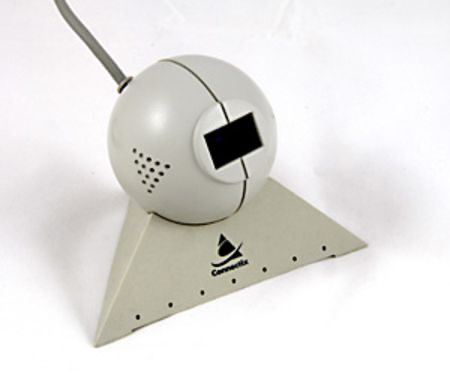
So, the Connectix Quickcam! The eyeball-shaped, greyscale camera, originally Mac-only and marketed before the web (and thus, the term webcam) was really a thing. Yet another great blast-from-the-past as a result of Doug’s “Whatever Happened to … ?” Sunday morning series!
(In chasing back looking for an image of the original, I discovered that Logitech — who still markets with the QuickCam name today — had purchased the product line from Connectix in 1998, and in doing so, I was reminded of a number of other Connectix products of the time, specifically Speed Doubler and RAM Doubler, software products that augmented the hardware back then make it work a little better before Moore’s Law really started to kick in. I also remember coming up with a idea for a great piece of wetware at the time — DayDoubler, which once installed into your body allowed you to double the amount of work you could complete in a day. Sadly, like other great vapourware of the time, it never materialized.)
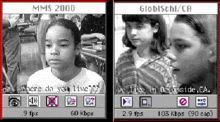
CU-SeeMe greyscale camera — Who remembers the Global Schoolhouse initiative?
Hurdles to Overcome
I have a sad, yet prescient, memory that took place in our curriculum office one day back then, shortly after a colleague and I set up two QuickCams and tested connecting to one another across our then-recently Ethernet-empowered room. The Manager of IT appeared in the doorway, and quickly expressed his frustration and concern that we might start encouraging the use of the cameras with the schools throughout the district during our visits! What? Wasn’t that part of what we were supposed to be doing? As it turned out, it was only one of many instances through the years when the system wasn’t ready for so rapid a change. In this particular case, I did understand his concern over the available bandwidth. Most of the world still lived on dial-up. However, the incident also emphasized that change, in education, can come quite slowly.
However, the incident also emphasized that change, in education, can come quite slowly.
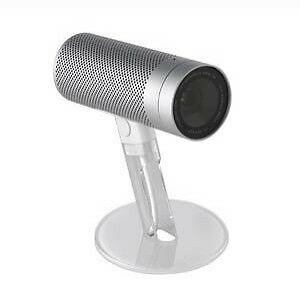
Moving forward in time, I remember when Apple marketed the iSight camera, a cylinder that fastened to the top of your laptop or monitor and provided its connection via FireWire, at the time a much faster protocol than the typical USB connection.
The colour camera included microphones, and existed until Apple had introduced built-in cameras across their computer and monitor product lines. With the introduction of Apple FaceTime — and the subsequent introduction of forward-facing cameras on iPhones, they renamed the conferencing camera the FaceTime camera, and relegated the iSight name to the camera on the back of iOS devices.
But the QuickCam was almost 25 years ago, certainly things have progressed a lot since then?
These days, I use the built-in webcam on my laptop when travelling, and external Logitech C920 camera at home at my desk. I have also used my Sony a6000 over HDMI, when I want to capture a really good image.
Of course, phones and iPads have forward facing cameras, which come in handy these days for communicating with family members during this virus-induced physical distancing.
As for meeting room software, over the past three weeks I’ve been in Google Meet/Hangouts on a daily basis, hosted around 30 Zoom sessions, used Slack videoconferencing a few times (not as easy, because it uses the system default microphone and speakers, rather than letting you configure them in the app), and then a one-off Skype call to the UK on Friday. Zoom certainly has the most features and back-end customizations, but with all the recent hype about Zoom security, a replacement may be coming down the pipe. Any recommendations, anyone? (I have fond memories of Elluminate from back before it was gobbled up by Blackboard, I tried it out again on Friday. Screenshare capabilities are too limited. However, kudos to Alec Couros (@courosa), Dean Shareski (@shareski), Sue Waters (@suewaters), Steve Hargadon (@stevehargadon), and Alan Levine (@cogdog) for the great memories from a decade ago!)
I was looking recently at upgrading my WebCam, and see that they are essentially out of stock. It’s not due to the lack of demand, but rather due to an increased demand. Everybody and his brother has been buying up WebCams since the shelter at home started to come into effect.
However, how prepared are we, as a system, 25 years later?
Which brings us to the present. Educators the world over are wrestling with what some are calling “Emergency Remote Teaching.” It’s not the same as eLearning, or Distance Learning, but webcams and conferencing platforms could be playing a role in helping teachers and students connect. However, how prepared are we, as a system, 25 years later? Lots of folks may have high-speed connections now , and webcams in their laptops now, but how prepared are we as a profession and as a society to make use of the technology to connect in the support of learning? What can we do to ensure there is equity of opportunity for all learners, and that the learning takes place in an environment as safe as our face-to-face classrooms?
If things had been planned out, as part of a longer term initiative, supported by all stakeholders, Emergency Remote Teaching might be better able to make use of webcams and conferencing tools. However, in this current state of duress, we’re likely to encounter a much more scattershot approach. It seems as if the change in education, as it did 25 years back, will still progress slowly.
Folding@Home simultaneously running two Work Units — one on the CPU and another on the GPU (graphics card). Please consider having your computer donate its “off time” to the cause!
Put your unused computing power to work in helping to fight the battle against the COVID-19 Coronavirus!
Perhaps you remember the SETI-at-home project from years back that allowed members of the public to dedicate unused processing power from their computers to help UC Berkeley churn through massive amounts of data from outer space in the search for extraterrestrial intelligence?
The same kind of opportunity now exists for your computer to help simulate protein folding for researchers who are working to find treatments for cancers and other critical afflictions. For the past 16 days, a small group of Ontario educators have turned their computers toward supporting the process to understand and combat the terrible COVID-19 virus. Kudos to Jim Pedrech (@jpedrech) and Tim King (@tk1ng) for getting us started.
We invite you to join us!
You can easily download the necessary software (Windows, Mac, or Linux) and get your computer up and “folding” in minutes! Enter team ID 239360 to have your Work Units (WU) recognized as part of team the OntarioEducatorsUnited contribution. So far we have completed over 200 Work Units.
Folding refers to the way human protein folds in the cells that make up your body. We rely on the proteins to keep us healthy and they assemble themselves by folding. But when they misfold, there can be serious consequences to a person’s health.
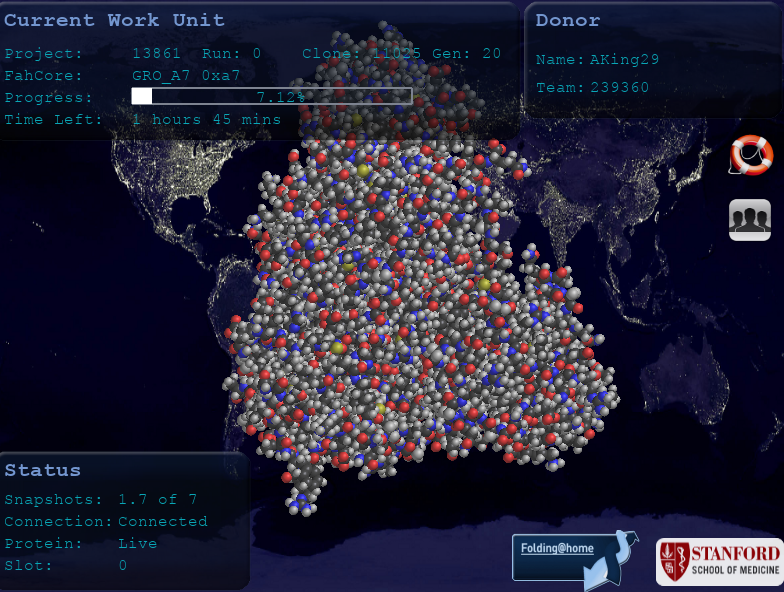
While your computer “folds” the protein pairs, you can see a visualizations of the kinds of things your computer is working on.
Visualization of Work Unit underway by Alanna King (@banana29)
Work Units are allocated by the software to your CPU, and in some cases they may be appropriate so as to be sent to a GPU. If you or your child has a gaming computerwith a dedicated graphics card, maybe it can be put to use during its daily downtime? (Gamers have to sleep sometime, SHOULDN’T THEY?).
I want to do this! Exactly what do I do?
1. Download and install the software for your computer. Once installed, it runs on its own in the background. You can get the nice web interface (shown in the GIF at the top of this post) by connecting to foldingathome.org/client once the software is running on your computer.
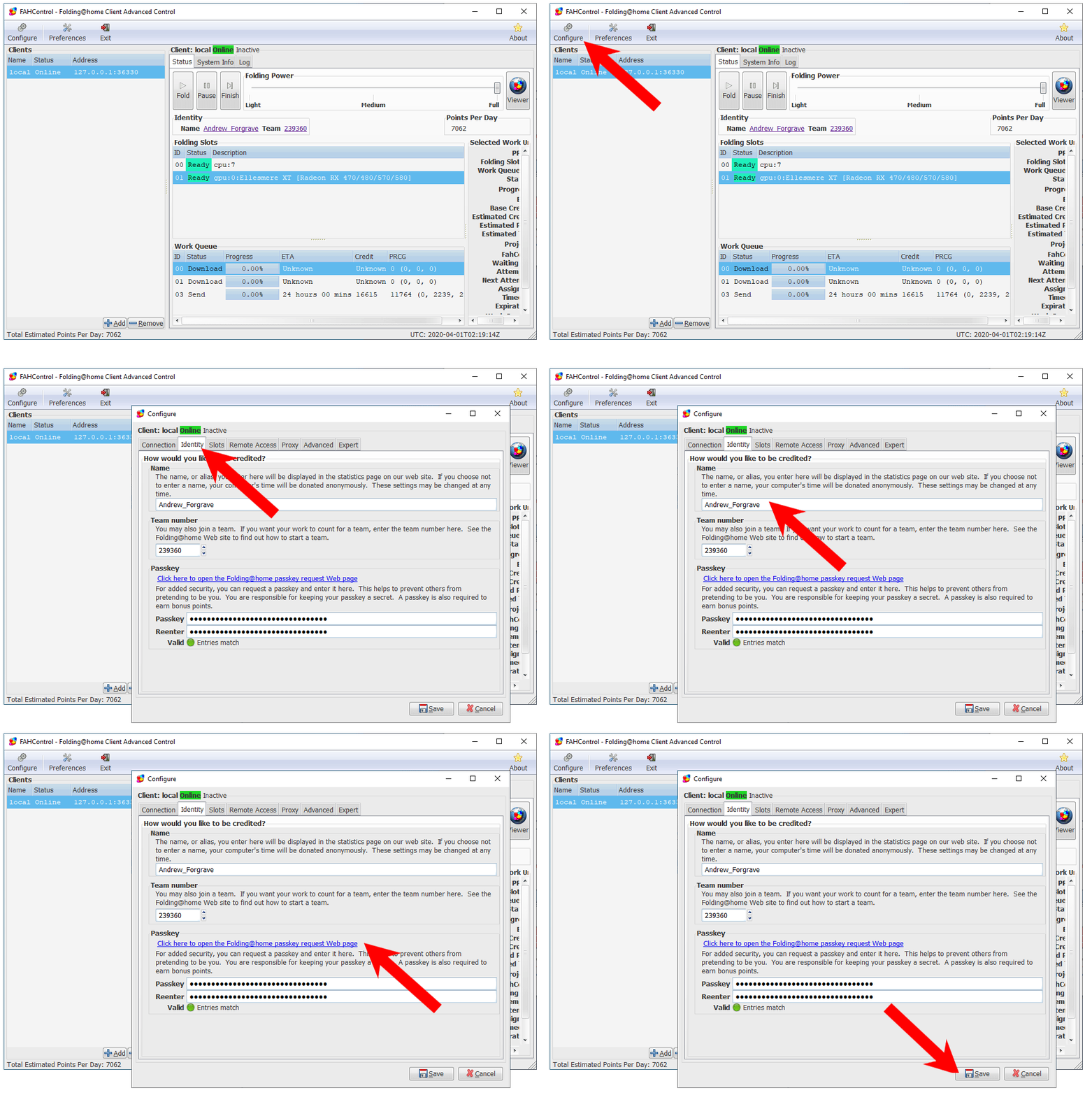
2. You can configure your client from either the Web Control or from within the actual FAHControl. Please contribute to Team 239360. If you include your name in the donor field, you will be listed on our team page as something other than Anonymous (Note: Don’t use your twitter handle with the @ symbol — it will be rejected and your contributions will show as unattributed on the team list — personal experience!)
3. You can stop the process at any time with the pause or finish button in the FAHcontrol or with the Stop Folding button in the Web Control. You can also determine how much of your computer’s unused thinking cycles will be devoted to folding by adjusting the Folding Power, again in either the FAHcontrol or the Web Control. Both interfaces provide an easy slider to let you give the application as little or as much thinking power as you wish.
While we can all hope that researchers and scientists will get a handle on the COVID-19 virus sooner rather than later — if you can put some computer thinking time towards the project (especially while you yourself are sleeping) — please do. Your computer — and you — can fight COVID-19!
It has been over two weeks since our new Minister of Education, Lisa Thompson (@LisaThompsonMPP, on Twitter) stated (six times) regarding Health and Physical Education, “in September, teachers will be using the 2014 curriculum.” As yet, there has been no official directive issued from the Ministry of Education to school boards in this regard, and the current 2015 HPE curriculum remains posted on the Ministry of Education web site. We are now just 3 weeks out from Labour Day, and the pending return to school.
In fact, just today I noted the following posted to Twitter:
Thirty public school boards have now made public statements in response to the proposed roll-back, along with statements of support for the current 2015 curriculum from an additional32 religious, legal, health and education organizations. Check out the Statements on the Rollback of the HPE Curriculum as collated by Andrew Campbell (@acampbell99, on Twitter).
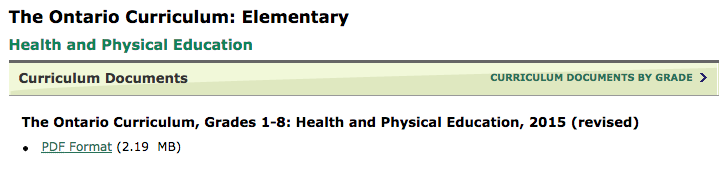
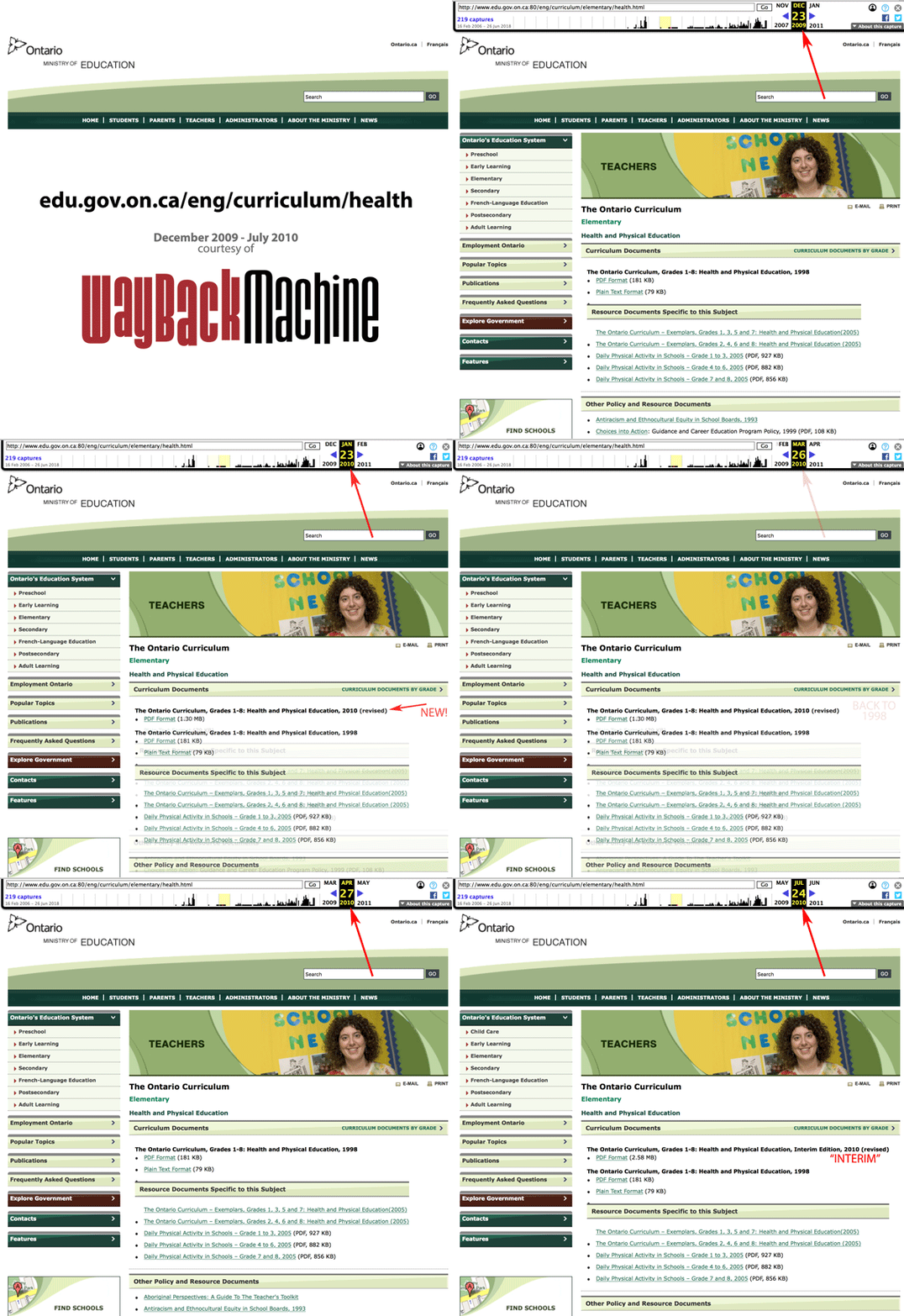
As uncovered in my previous post, Clarifying the Ontario Health and Physical Education Curriculum, the curriculum in place in 2014 (March 25th, to be exact, as uncovered via The Wayback Machine) was The Ontario Curriculum, Health and Physical Education, Interim Edition, 2010 (revised). Were the Ministry of Education to follow through on their rollback to “the curriculum teachers were using in 2014,” one would assume that this would be the document they would reference.
I decided it might be instructive to do a bit more digging and see if I could find the document that was released PRIOR to the Interim Edition, 2010 (Revised), given that the Interim Edition was the re-release of the 2010 (Revised) document that caused considerable consternation.
Back to The Wayback Machine
A bit of poking around by paging backward on The Wayback Machine from edu.gov.on.ca/eng/curriculum/elementary/health showed that the first appearance of the previously controvertial 2010 (Revised) document occurred between December 2009 and January 2010.
Following the initial January 2010 release, the 2010 (Revised) document lived on the Ministry of Education website for a period of several months of calm, before a sudden condemnation caused a media fury in late April, and resulted in an abrupt about-face by then-Premier Dalton McGuinty. The 2010 (revised) document was withdrawn, and a couple months later the Interim Edition, 2010 (revised) appeared on the Ministry site. It is this curriculum version — essentially the 2010 Health and Physical Education document with the 2010 Human Development and Sexual Health section removed and the 1998 Growth and Development section inserted — that would be “the curriculum teachers were using in 2014.”
As part of this research, I came across a very interesting paper by David Rayside (University College, UT), presented at the Annual Meeting of the Canadian Political Science Association, Concordia University, Montreal, June 2010: Sex Ed In Ontario: Religious Mobilization and Socio-Cultural Anxiety. The paper documents in very significant detail the various pressures in play at the time and the significant work done during the period 2007-2009 in preparing the 2010 (Revised) version.
Here are only a couple of excerpts:
From the beginning these discussions included Catholic educators, who seemed no different from public system educators in the numbers of them calling for change in the sex education component to HPE. The Ontario English Catholic Teachers Association had become an advocate for greater attention to LGBT issues, and did not shy away from advocating change in elementary schools. They recognized how much information students were getting about sex from outside the school, and most of them agreed that bullying and harassment based on sexual difference required concerted attention. There are no indications that Catholic educators consulted over the new curriculum were out of alignment with those public school educators who were calling for significant updating of the approach to sex education.
After the January 18th posting and distribution, silence followed. Many many people knew about the curriculum; thousands had been involved in consultations; hundreds of school board officials in both Catholic and public systems knew about it and then received copies of it in January. Some would already have sent the new curriculum through the system to ensure adequate preparation for September.
If you are interested in understanding (as I was) more of the background and behind-the-scenes political forces, I recommend the paper to your attention. Suffice to say, this one paragraph says a lot:
On the morning of April 20th, 2010, veteran anti-gay evangelical crusader Charles McVety issued a press release denouncing a new Ontario sex education curriculum, and calling for protest against it. Fifty-four hours later, Premier Dalton McGuinty withdrew what were seen the most controversial sections of the Health and Physicial Education document (HPE) for a “re-think.” This was an unusual and embarrassing reversal for a Liberal leader widely viewed as strategically canny.
Now, it was interesting to note that I was unable to obtain an active link to the initial release from 2010 (Revised) document. Unlike the 1998, 2010 Interim Edition (revised), and 2015 (Revised) documents, the short-lived 2010 (Revised) document is not archived on The Wayback Machine.
However, the file name in the URL gave sufficient direction to lead me via a simple Google search (look for health18curr2010.pdf) to a copy of the actual document still available on a third-party website.
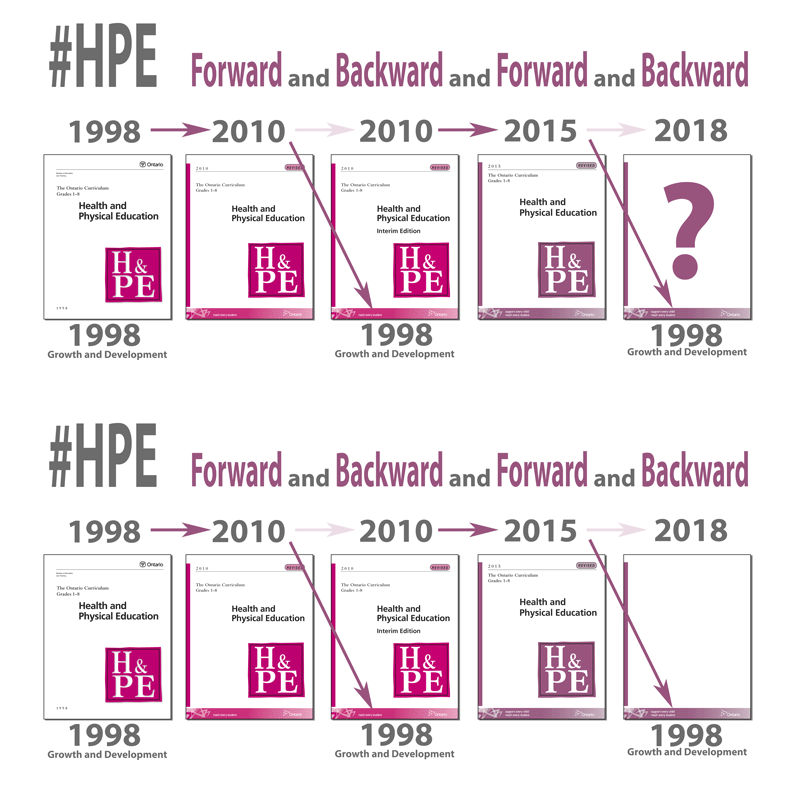
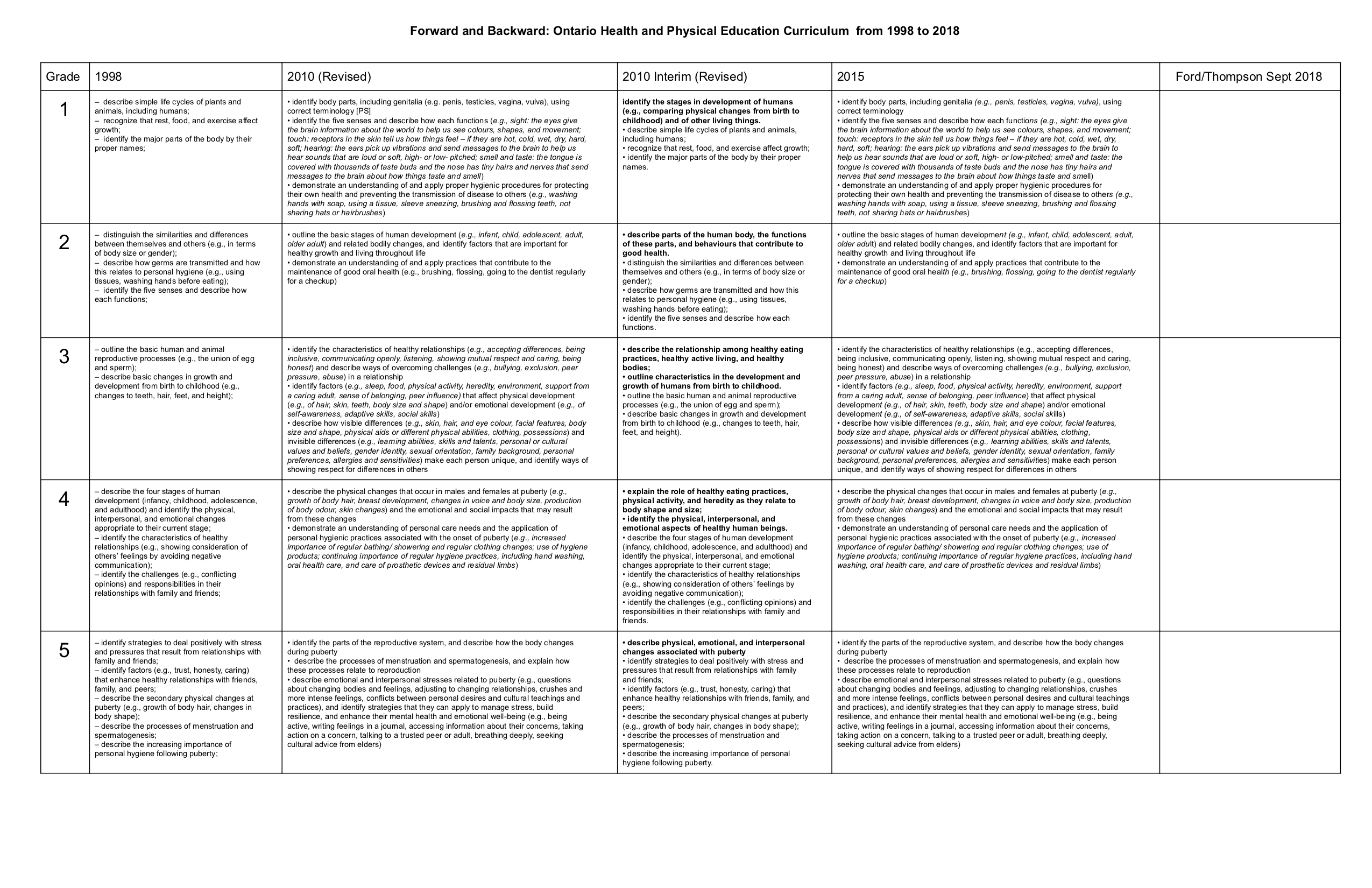
In trying to understand what was controversial enough to be withdrawn in 2010, and what might now be controversial in 2018 again three years after the implementation of the 2015 document, I have done a document-by-document comparison of the contested sections of the documents: 1998, 2010 (Revised), Interim Edition 2010 (Revised), and 2015 (Revised).
You can click on the image above to get a full-screen view of the comparative PDF, but essentially there is clearly a forwards and backwards battle underway with the safety of Ontario’s children at stake. If the current government has its way and officially rescinds the 2015 curriculum, then the old Growth and Development section will once again be in force, throwing that component of Ontario Health education back to 1998.
That 62 stakeholder organizations, including The United Church of Canada Ministers, the Metropolitan Community Church, the Ontario Principals’ Council, The Elementary Teachers’ Federation of Ontario, Society of Obstetricians and Gynaecologists of Canada, Registered Nurses Association Ontario, Anishinaabe Nation, Ontario English Catholic Teachers’ Association, Ontario Public School Boards Association, Catholic Principals’ Council, Canadian Civil Liberties Association, Ontario Federation of Home and School Associations, Association of Ontario Midwives, Ontario Physical and Health Educators’ Association, and 30 Ontario public school boards, have come out in support of keeping the 2015 curriculum should give this government serious pause before they send us back 20 years.
Sadly, should Minister Lisa Thompson rise to the challenge and respond to the very real need to provide educators with greater clarity around the “2014” curriculum, she need only copy the text from either the first or third columns of the comparison table, and paste it into the fifth column, which I have relabeled in advance as “Ford/Thompson 2018.”
With that simple act, coupled with a quick cover memo to the Directors of Education throughout Ontario, she would make her throwback 20 years to the 1998 curriculum complete.