The Future is Already Here 8
 The Future is Already Here … it’s just not very evenly distributed.
— William Gibson
Attribution
Listen to the NPR Interview Nov 30, 1999
Ontario educator Doug Peterson (@dougpete on Twitter) sent out a tweet yesterday morning which immediately caught my attention, “Just blogged: Great opportunity for Ontario Teachers. Yesterday, the Ministry of Education announced …”
A short link through to Doug’s Off the Record blog had me reading about the immediate availability of a new piece of OSAPAC-licensed software for use in Ontario publicly-funded schools, Bitstrips for Schools. The Ontario Ministry of Education, supported by the direction of OSAPAC, had finalized licensing arrangements to procure a modified-for-education version of the existing Bitstrips, and was announcing that the augmented site was ready-for-access by Ontario teachers and students. Not only would the modified version provide an “education-friendly” environment, but it would also include an easy-to-use management framework.
Here’s my first attempt with the software (with a small measure of editorializing thrown in for spice):
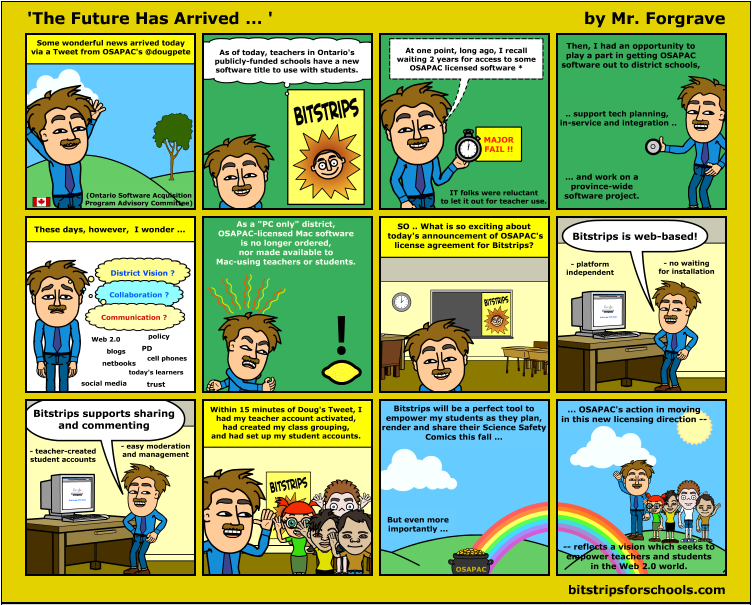
So, as referenced in piece above, shortly after reading Doug’s post, I was on the Bitstrips For Schools site. Within mere moments, I had activated my account, created a class grouping, and set up my student accounts. (The registration page included a drop down selector for school district, and then school — it then validated against my district email account. Easy Peasy.)
And it is in this ease-of-access that I find a profound potential.
The ease with which Ontario teachers can access this new software application, with all of its attendant student-collaboration potential, is unheard of in my experience for an OSAPAC release. (Certainly the local implementation of Gizmos, for example (another OSAPAC-licensed web-app) — and the attendant user codes — have yet to make their way out into our schools from the district office. Not sure what’s up with that.) Granted, some teachers may require some support and/or training to make use of this software. Finding an appropriate curriculum context will also be important for others. But there’s no doubt in my mind that students will take to this with ease. The fact that it requires NO installation or subsequent technical support on the part of district IT departments, however, really strikes my fancy. And the ability for students to access the web-app from home, bodes well for where we need to be going. As an initial case-study, I see this as a wonderful indication of what is potentially to come. If the easy registration of teacher accounts and subordinate student accounts (as established via OSAPAC/EDU) works in this application, then it paves the way for OSAPAC and the Ministry of Education to employ the same strategy in rolling out other web/cloud-based applications. The sooner, the better. A provincially-licensed blogging or writing process tool, anyone?
Granted, this may run the risk of being potentially perceived by some as a bit of a challenge to local district edicts/policies — if they’re not already onboard — but I hope not. After all, the times, they are a’ changing. With eLearning providing education directly to some students in their homes already, we all need to be looking forward and embracing the aspects of educational technology that can truly work to empower learners and educators alike.
As for the Gibson quote, there’s no doubt that the uneven distribution of the future remains a significant issue for us all to wrestle with.
But I, for one, applaud OSAPAC and the Ministry for their vision in taking this step forward. This act clearly demonstrates the potential for a more even distribution of the future moving forward … 🙂
What are your thoughts? Is this a good way for OSAPAC and the Ministry to keep moving?


 First, a disclaimer. I am a Canadian educator, teaching in a middle school in Ontario, Canada. Are you surprised to know that I intend to screen the speech and discuss it with my students grade 7 students on Tuesday? Why, you might ask?


 I recall my very first “new teacher induction meeting,” all those years ago (19, I think), when the then-Director of Education for the district assembled all of the new hires together during the last week of August (right about now, say) and welcomed us with a visionary and passionate speech about the careers upon which we were about to embark. I remember remarking at the time that he was one of the most eloquent and dynamic speakers I had ever heard, and was conscious at the time of his powerful use of metaphor and careful, poet’s choice of words in crafting his talk. I was impressed to the point that I was motivated to go up and speak with him when the session ended. (Imagine that, a new teacher, approaching the Director of Education on the first day of induction — and yet, why not?). Our conversation continued from the meeting room along the hallway, and concluded at his office, where he picked up a recently released book of essays on literacy from his desk and offered it to me to take away and use with my students. Imagine that. Welcome, and here’s a Vision, and here’s a Book of Inspiration.
 Shortly thereafter we lost close to half of our PA days, and (regardless of that) never since have we had an opportunity to assemble as a whole district group to hear the Director speak and feel that common bond of pulling together with a shared and enumerated vision. The Director still has an address each August for the school administrators and central office staff, but it’s by invitation only, and the closest we get to it is the chance to download a narrated Powerpoint slide deck. Maybe this year’s address will be video recorded and posted for all to view, but somehow, something is lost without the face-to-face oration, without that opportunity to physically gather together and participate, and without that serendipitous moment to maybe have a chat with the Director.