Monthly Archives: August 2009


Collaborating and Leading to Promote a Shared Vision 2

Establishing a vision to work towards is an important component of implementing and achieving positive movement forward. Without a vision, it can be all to easy to spend a lot of time doing a lot of things that don’t colletively contribute to anything. Without a shared vision, it can be truly difficult to “get all the ducks marching in the same direction,” or difficult to marshal and deploy the appropriate resources. And without a clear, shared vision, it can be difficult for stakeholders to have a sense what you’re all about, whether it is of any value to them, and close to impossible for them to know whether you’re achieving any success with it at all.

“You’ve got to think about big things while you’re doing small things, so that all the small things go in the right direction.”
— Alvin Toffler

MoreThanWordsCanSayI recall my very first “new teacher induction meeting,” all those years ago (19, I think), when the then-Director of Education for the district assembled all of the new hires together during the last week of August (right about now, say) and welcomed us with a visionary and passionate speech about the careers upon which we were about to embark. I remember remarking at the time that he was one of the most eloquent and dynamic speakers I had ever heard, and was conscious at the time of his powerful use of metaphor and careful, poet’s choice of words in crafting his talk. I was impressed to the point that I was motivated to go up and speak with him when the session ended. (Imagine that, a new teacher, approaching the Director of Education on the first day of induction — and yet, why not?). Our conversation continued from the meeting room along the hallway, and concluded at his office, where he picked up a recently released book of essays on literacy from his desk and offered it to me to take away and use with my students. Imagine that. Welcome, and here’s a Vision, and here’s a Book of Inspiration.

“Really great people make you feel that you, too, can become great.”
— Mark Twain

“If your actions inspire others to dream more, learn more, do more and become more, you are a leader.”
— John Quincy Adams

Fast forward a bit, say three or four years later. Back then (in the olden days, before a goodly number of our Professional Activity days were removed by government decree in the mid-nineties) we used to have a designated “Federation Day,” which was a once-a-year opportunity for ALL of the teachers in the district to assemble in one spot for a day of teacher-provided sharing and self-selected workshops. I recall this one particular day, because yet again, the Director of Education (different director, mind) took the opportunity to speak to all of the assembled teachers (I’ll say perhaps 1 300 at the time). The wonderful impact upon me was again to reinforce that we, as a massed collective, newer and experienced teachers alike, were all working together to achieve a common vision. Again, powerful, motivating and, I think, important.

“If you want to build a ship, don’t herd people together to collect wood and don’t assign them tasks and work, but rather teach them to long for the endless immensity of the sea.”
— Antoine de Saint-Exupery

“Nurture your mind with great thoughts, for you will never go any higher than you think.”
— Benjamin Disraeli
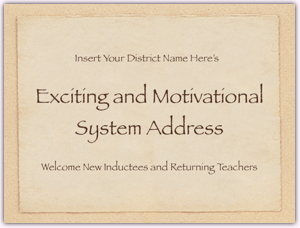
DistrictAddressShortly thereafter we lost close to half of our PA days, and (regardless of that) never since have we had an opportunity to assemble as a whole district group to hear the Director speak and feel that common bond of pulling together with a shared and enumerated vision. The Director still has an address each August for the school administrators and central office staff, but it’s by invitation only, and the closest we get to it is the chance to download a narrated Powerpoint slide deck. Maybe this year’s address will be video recorded and posted for all to view, but somehow, something is lost without the face-to-face oration, without that opportunity to physically gather together and participate, and without that serendipitous moment to maybe have a chat with the Director.

So then

  • Is this the norm within education organizations today?
  • Is the collaborative development and sharing of a “big picture” direction part of your experience?
  • How do you draw strength, support, and validation for the mission that you take to your classroom and your students?
  • From whence comes your vision?

One School's Vision 1

The recent appearances of Tornados here in Ontario (including both Watches and Warnings from Environment Canada in my area) have reminded me of a most excellent entry submitted to the NECC 2009 Digital Storytelling Contest. I first viewed this film back in June, while perusing the various entries, prior to attending NECC in DC.

At the time, I was struck by the irony inherent in the story, in which a school, devastated by a tornado strike, was fortunate enough to benefit from considerable leadership so as to re-vision the school to coincide with the re-building and repairs. Build for the future, rather than re-build the past. (I was shortly thereafter pleasantly surprised when I realized that the school was from a district here within Ontario. I was even more pleased to have the opportunity to meet up with the film’s creator and her principal at NECC a few short weeks later, and sitting down to chat with them over dinner.)

Following damage by a tornado and a two-year reconstruction, Lawfield Elementary School in Hamilton Wentworth DSB, Ontario reopened with a newly revitalized vision. View this short 5 minute video to see how learning is described for the 21st Century learners.

So?

Opportunities for school plant renewal do not come frequently. In many non-growth districts (read outside of major metropolitan areas experiencing urban sprawl), declining enrollment typically results in the converse, school closures. Opportunities to infuse new money into buildings and re-allocate resources for major expenditures are very rare. Amortizing payments for renewal on a building that you may or may not need twenty years down the road can give one considerable pause for thought. As a simple example, consider something as ubiquitous as the kitchen (classroom) sink. Chances are, if they weren’t installing the plumbing for sinks in classrooms when a school was built (50 years ago, say), then those classrooms today STILL do not have sinks or running water — tearing up the concrete floors to run piping is just too expensive — so it will never happen in that building. (And let’s not even touch the issue of portables …)

One must seize the opportunity to renew for the long term when the opportunity arises.

How would YOU approach the opportunity of school renewal?

a) in terms of program re-vision/re-focus/re-structure?
b) in terms of teaching spaces (classrooms, if you wish)?
c) in terms of resources?

Please take a moment to comment with your list of essentials or wishes.
Rationales are also most welcome!


A Great Opportunity — and What Really Needs to Happen Next

OPSBA’s “What If? Technology in the 21st Century Classroom”

WhatIf_CoverNow with regards to a shared vision for educational technology, let me say that I’ve been trying to sort out the big picture here in my district and in Ontario for some time now. (I was involved in a Ministry of Education project for a five year term a number of years back, and so I had an opportunity at that point to gain some small insight into things then. But more recently, no.) And so perhaps you can imagine my enthusiasm when I came across a document entitled “What If? Technology in the 21st Century Classroom,” published by the Ontario Public School Boards’ Association (OPSBA).

Prepared by a cross-province group of trustees, directors, and technology heads, the OPSBA document was released on April 28th, 2009, and although the downloadable PDF version of the document was curiously dated April 1st, I decided that it wasn’t an April Fool’s joke, and was thus worthy of serious consideration. What If? is clearly targeted at engaging groups such as the Ontario Ministry of Education, the various teachers’ groups, and the general public in a discussion about some very important questions about role of technology in education and learning in the current and near future. The document attempts to create a space for dialogue among various stakeholders by presenting an achievable vision of edTech for Ontario classrooms. The vision highlights various initiatives underway in different Districts within the province.

While the whole document bears reading, my first inclination is to draw the readers attention to the numbered pages 25-27, where a “day in the life” portrayal of the envisioned near-21st Century school is portrayed. You’ll note references to various technologies such as SMART Interactive Whiteboards and WiFi-enabled 1:1 netbooks, but the specified tech is presented as part of an integrated vision that includes variations in classroom structure, learning experiences, day-to-day activities undertaken by students, teachers, and administrators, and reflects an amalgam of various bits and pieces currently in play within different Ontario districts. (see the section titled Classroom 2.0: Technology Engages Student Learning, by Mark Bailey, pgs 25-27. Bailey is a both a Trustee and an infoTech expert. If interested, you can hear him interviewed by the CBC, including a few call-ins from the public by following this link.) Coming in at a bit less than 30 booklet-sized pages (~15 page PDF), What If? can be purused in a decent time frame — and is well worth the time if you have any interest (Ontario educator or otherwise) in seeing what such a group can present as a realistic and tentative straw model.

An excerpt from the “day in the life” portrayal:

As they do every time, the 20 students filing into Nora Smith’s grade 8 history classroom each grab a random netbook off the rack and head to their assigned four-student team station. Jack sits at his assigned space, plugs his netbook into the power cord built into the desk and logs in wirelessly to the central server, using a username and password. The central server’s timetable database recognizes that Jack is in history class and identifies the three other members of his student team based on information that Smith submitted earlier in the year.

The screen on Jack’s netbook is populated with several pieces of relevant information, broken down into windows. First, there is the overview of today’s lesson. Next, Jack’s personal documents and multimedia files related to the class are listed. Finally, there is an instant messaging box that connects Jack to his team and to their teacher. Jack notes that today’s lesson is titled “The Life of Louis Riel.”

(What If? Technology in the 21st Century Classroom, pg. 25, paragraph 2)

And this is where I see a Great Opportunity — and What Really Needs to Happen Next.

Because, you see, this document, for all its wonderful potential, has been unleashed, accompanied by a press release, in a very close-to-traditional 1.0 media manner. Yes, it is posted on a website for ready access. Yes, it was supported by the CBC radio interview. And it does invite input, right there on page 20, buried in a paragraph, with a simple email address link (ITinSchools@opsba.org). What’s missing, in the 2009 Web 2.0 world, is an online space for public commenting and open, interactive discussion. That would go a long way to letting everyone participate in crowdsourcing input for a truly collective, shared vision. Yeah, Ontario is a big province, with many voices to potentially contribute and discuss. But that’s the great strength of our new 2.0 world, engaging folks and providing an opportunity for collaboration.

I’ve just now sent an email to ITinSchools@opsba.org, suggesting that they do set up a comment stream. In the meantime, if you take the time to review the document (do!), perhaps we can collect a few comments down below, perhaps discussing the content and your process in the interim.

The other thing that needs to happen, is that folks (in Ontario specifically) need to see that the document is shared with and discussed by those who need to read it and think about it. The evening I first read the document, I sent off emails to my principal, our senior IT guy, and the president of our ETFO office, along with a few of my local edTech tweeps, commenting on the document and pointing them to the press release and actual PDF document.

Maybe this is old hat for you, and maybe your district is actively engaged in discussing What If? and planning some next steps in direct response to it. If so, I’m sure we’d be interested in hearing about what you’re up to. (Comments?) If not, who would you see as key players in your district that you think need to ponder the What If? question? Maybe they just need an extra invite to get involved in the discussion?

“The greatest danger for most of us is not that our aim is too high and we miss it, but that it is too low and we reach it.”
— Michelangelo